
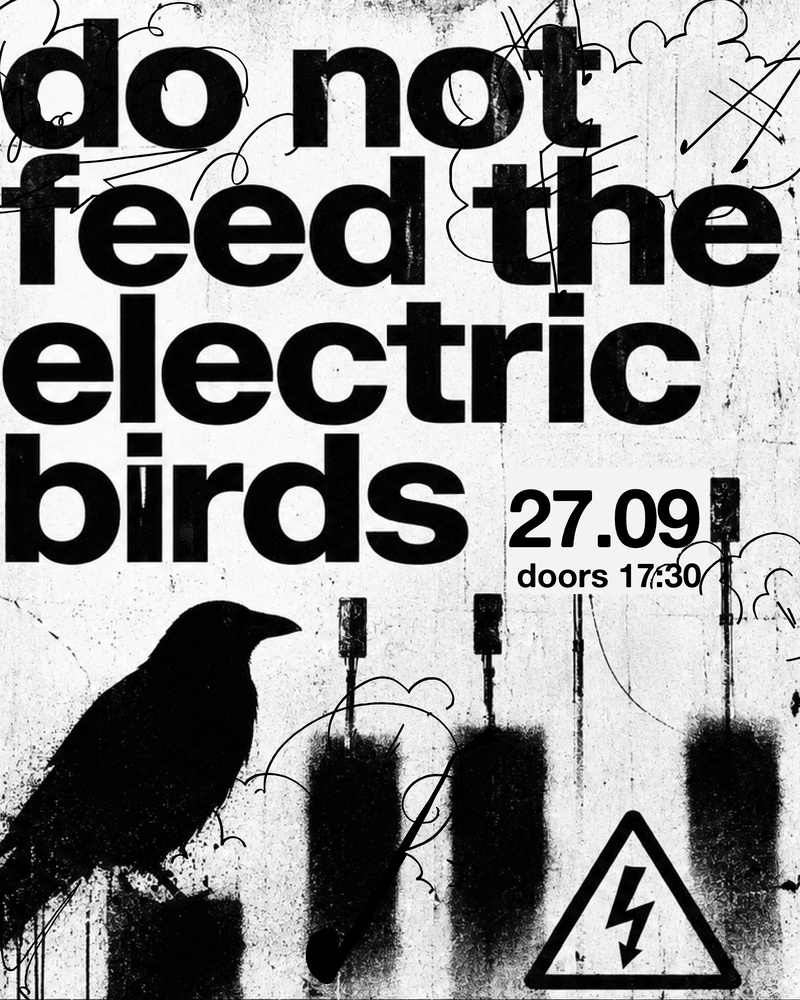
do not Feed the Electric Birds - Marco Fusi & Scott McLaughlin
TAKE YOUR PRESALE, SAVE 5.- ON YOUR TICKET
𝐸𝑁
Live performances are two-day micro-residencies in the venue, in order to prepare a performance adapted to the venue and in line with the proposed technology. Our aim is for each performance to be unique in terms of its relationship with sound, visuals and the space between audience and artist.
𝐹𝑅
Les performances lives sont des accueils de micro-résidence de deux jours dans la salle, afin de pouvoir préparer une représentation adaptée à la salle et en lien avec la technologie proposée. Nous souhaitons, pour chacune de ses performances, qu’elle puisse offrir une singularité sur le rapport avec le sonore, le visuel ou entre public et artiste dans l’espace.
𝐷𝐸
Live-Aufführungen entstehen jeweils im Rahmen von zweitägigen Mikroresidenzen am Veranstaltungsort. Ziel ist es, eine an den Raum und die angebotene Technologie angepasste Darbietung vorzubereiten. Jede Aufführung soll einzigartig sein, insbesondere in Bezug auf das Zusammenspiel von Klang, Bild und der Beziehung zwischen Publikum und Künstlerinnen bzw. Künstlern.
Sunday 27 September 2026
 Google calendar
 Outlook
 iCal
iCal
MIAM – Fribourg
- Doors open at:
17:30 - Event starts at:
18:00
Organized by: MIAM
Marco Fusi & Scott McLaughlin
𝐸𝑁
Strings that vibrate by themselves. Resonances that shift without warning. Two performers sharing control of instruments that seem to develop a life of their own.
do not feed the electric birds is an immersive performance of for viola, viola d’amore, Lorentz-force actuation and spatialised sound. Marco Fusi and Scott McLaughlin transform the string instrument into a volatile acoustic-electromagnetic system in which bowing, touch, feedback and magnetic forces continuously reshape one another.
At the heart of the performance is a Lorentz-force system developed in collaboration with Adam Schmidt at the Augmented Instruments Lab, Imperial College London. Electrical current is sent directly through conductive strings, allowing magnetic fields to set them into vibration. The electronics do not simply process the sound: they enter the instrument itself, activating its strings and changing the way it responds.
Fusi bows, stops, dampens and prepares the viola and viola d’amore while McLaughlin intervenes in the forces driving their vibration. Sounds emerge, collide, disappear and return in altered forms. Control is constantly exchanged between performer, instrument and system, creating a music that is unpredictable, physical and intensely responsive.
At MIAM, this unstable sonic world expands throughout the room. Spatialisation becomes an active part of the improvisation, sending resonances across and around the audience and turning the listening space itself into an extension of the instruments.do not feed the electric birds grows out of an ongoing collaboration between Fusi and McLaughlin around experimental string practice, feedback and instrumental transformation, developed in collaboration with HEMU Fribourg-Freiburg and the University of Leeds.
𝐹𝑅
Des cordes qui vibrent d’elles-mêmes. Des résonances qui se déplacent sans prévenir. Deux interprètes se partagent le contrôle d’instruments qui semblent peu à peu prendre vie.
do not feed the electric birds est une performance immersive pour alto, viola d’amore, actionnement par force de Lorentz et son spatialisé. Marco Fusi et Scott McLaughlin transforment l’instrument à cordes en un système acoustique et électromagnétique instable, dans lequel archet, toucher, feedback et forces magnétiques se reconfigurent continuellement.
Au cœur de la performance se trouve un système fondé sur la force de Lorentz, développé en collaboration avec Adam Schmidt au sein de l’Augmented Instruments Lab de l’Imperial College London. Un courant électrique est directement envoyé à travers les cordes conductrices, permettant aux champs magnétiques de les mettre en vibration. L’électronique ne se contente donc pas de traiter le son : elle pénètre au cœur même de l’instrument, activant ses cordes et modifiant sa manière de réagir.
Fusi joue de l’alto et de la viola d’amore, les frottant à l’archet, les arrêtant, les étouffant ou les préparant, tandis que McLaughlin agit directement sur les forces qui mettent les cordes en vibration. Les sons apparaissent, se heurtent, disparaissent et reviennent sous des formes transformées. Le contrôle circule constamment entre l’interprète, l’instrument et le système, donnant naissance à une musique imprévisible, physique et d’une grande réactivité.
À MIAM, cet univers sonore instable se déploie dans tout l’espace. La spatialisation devient une composante active de l’improvisation, faisant circuler les résonances autour et au travers du public, et transformant l’espace d’écoute lui-même en une extension des instruments.
do not feed the electric birds est issu d’une collaboration continue entre Fusi et McLaughlin autour des pratiques expérimentales de la corde, du feedback et de la transformation instrumentale, développée en collaboration avec la HEMU Fribourg-Freiburg et l’Université de Leeds.
𝐷𝐸
Saiten, die von selbst zu vibrieren beginnen. Resonanzen, die sich ohne Vorwarnung verändern. Zwei Performer, die gemeinsam die Kontrolle über Instrumente teilen, die scheinbar ein Eigenleben entwickeln.
do not feed the electric birds ist eine immersive Performance für Viola, Viola d’amore, Lorentzkraft-Aktuierung und räumlich verteilten Klang. Marco Fusi und Scott McLaughlin verwandeln das Saiteninstrument in ein unberechenbares akustisch-elektromagnetisches System, in dem Bogenführung, Berührung, Feedback und magnetische Kräfte einander kontinuierlich beeinflussen und neu gestalten.
Im Zentrum der Performance steht ein Lorentzkraft-System, das in Zusammenarbeit mit Adam Schmidt vom Augmented Instruments Lab am Imperial College London entwickelt wurde. Elektrischer Strom wird direkt durch leitfähige Saiten geleitet, sodass Magnetfelder diese in Schwingung versetzen können. Die Elektronik verarbeitet den Klang nicht einfach nur: Sie wird selbst Teil des Instruments, aktiviert dessen Saiten und verändert die Art und Weise, wie es reagiert.
Fusi streicht über die Saiten, stoppt, dämpft und präpariert Viola und Viola d’amore, während McLaughlin in die Kräfte eingreift, die ihre Schwingungen antreiben. Klänge entstehen, kollidieren, verschwinden und kehren in veränderter Form zurück. Die Kontrolle wird ständig zwischen Performer, Instrument und System ausgetauscht. So entsteht eine Musik, die unvorhersehbar, körperlich und unmittelbar reagierend ist.
Im MIAM entfaltet sich diese instabile Klangwelt im gesamten Raum. Die räumliche Verteilung des Klangs wird zu einem aktiven Bestandteil der Improvisation: Resonanzen bewegen sich durch und um das Publikum und machen den Hörraum selbst zu einer Erweiterung der Instrumente.
do not feed the electric birds entsteht aus einer fortlaufenden Zusammenarbeit zwischen Fusi und McLaughlin rund um experimentelle Saitenspielpraxis, Feedback und die Transformation von Instrumenten. Das Projekt wurde in Zusammenarbeit mit der HEMU Fribourg-Freiburg und der University of Leeds entwickelt.